
With more than 50 percent of the ICS workforce having less than five years of experience, this gap poses a substantial risk to securing critical industrial infrastructure. The findings emphasize the urgency of investing in human capital to protect against increasingly sophisticated cyber threats, according to the SANS 2024 State of ICS/OT Cybersecurity Report, sponsored by OPSWAT.
The report, which gathered data from more than 500 cybersecurity professionals in ICS/OT environments, points to a workforce shortage in industry-specific certifications. To that end, 51 percent of respondents reported lacking formal cybersecurity credentials, further compounding the challenge of securing industrial systems.
Lack of Experience ‘a Major Concern’
“The lack of a well-trained, experienced ICS/OT workforce is now a major challenge in ensuring the safety and resilience of critical infrastructure,” said Eric Knapp, CTO of OT at OPSWAT. “We need to shift our focus to empowering our people with the right tools and knowledge to manage increasingly complex cyber risks in ICS and OT environments.”

As organizations increasingly prioritize technology investments to protect their operations, the report signals the need for a more balanced approach that emphasizes workforce enablement. While technological solutions are important, the growing complexity of ICS/OT environments requires a skilled and certified workforce to manage emerging risks effectively.
Indeed, the workforce is the beating heart of any ICS/OT security program.
Moreover, a trained and experienced team can help inform strategies, what technologies to invest in, and the best approaches for managing industrial cyber risk.
As industrial environments become more interconnected, the convergence of IT and OT roles is increasingly common. Survey data shows 36 percent of respondents are responsible for IT and OT security, reflecting this growing integration. However, this trend is not universal; 34 percent of respondents still focus exclusively on OT/ICS operations, and 24 percent are dedicated primarily to IT/business enterprise activities – splitting the “IT vs. OT” camps into similar populations.
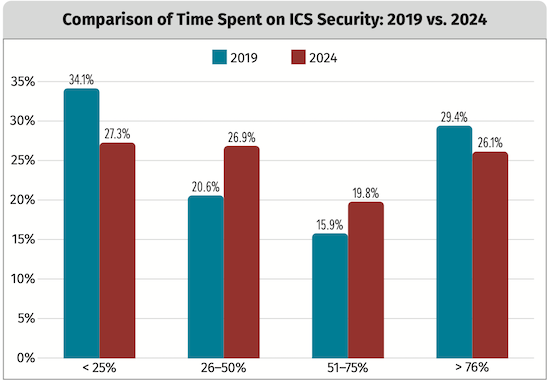
Chart compares time security professionals spent on ICS security from now to five years ago.
Source: SANS
Regardless of their IT/OT placement, respondents reported, on average, they spend over half of their time on ICS cybersecurity. The time allotment has shifted over the past five years. Although ICS/OT cybersecurity is still a “part-time job” for many respondents with just over 12 percent of respondents in 2024 described ICS/OT cybersecurity as taking all of their assigned duties.
Execs Eye Governance
Governance of ICS/OT cybersecurity is drawing more attention at the executive level, but there are still significant gaps between perceived risks and actual investments.
Survey numbers indicate the responsibility for setting ICS security policies is increasingly centralized within the executive leadership, with a clear emphasis on integrating ICS security into the broader corporate security strategy.
In terms of strategy, CISOs are the main drivers of ICS security governance (39 percent), integrating it with corporate security strategy. Respondents also highlighted CIOs or CTOs contribute to ICS security policies (14 percent), further converging ICS security with IT governance and indicating most organizations centralize ICS security within the enterprise.
Strategies often emanate from standards and the survey showed most organizations (72 percent) map their control systems to recognized frameworks, with the NIST Cybersecurity Framework being the most popular (45 percent).
Other standards, such as ISA/IEC 62443 and NERC CIP, also see wide use, showing a strong commitment to standardizing and strengthening ICS security practices. However, standard mapping depends on who governs ICS security. If a CISO owns the governance, 82 percent of ICS programs follow industry standards, compared to only 42 percent if there are no corporate-wide policies for ICS.